East European Diasporas, Migration and Cosmopolitanism by Ulrike Ziemer Sean P. Roberts
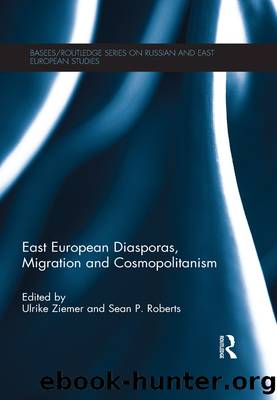
Author:Ulrike Ziemer, Sean P. Roberts [Ulrike Ziemer, Sean P. Roberts]
Language: eng
Format: epub
ISBN: 9780415517027
Barnesnoble:
Publisher: Taylor & Francis
Published: 2012-11-08T00:00:00+00:00
Interethnic sociability
The state of Kazakhstan is generally understood as taking up the Soviet policies of internationalism and interethnic harmony while equally promoting ethnic Kazakhs. In this ambivalent endeavour, politicians seek to strengthen a supra-ethnic Kazakhstani identity (Cummings 2006; Dave 2007; Diener 2004; Holm-Hansen 1999; Oka 2006). In the following, I elaborate the concept of internationalism in Soviet times and present-day Kazakhstan by looking at the policiesâ output in terms of practices of sociability and peopleâs attitudes towards others.
Though the concepts of nations and nationalities have no place in Marxism, since they are an essentially bourgeois phenomenon, they received a key role in organizing and controlling the Soviet people (Hirsch 2005; Martin 1998, 2001; Pilkington and Popov 2008; Slezkine 1994). However, at the same time, nations and nationalities were largely depoliticized identities and Soviet internationalism is usually characterized as formalism resting on cultural presentations like dancing or singing, which are performed by ethnically defined groups (cf. Humphrey 2004: 146; Hirsch 2005: 269â71).
Humphrey (2004) has investigated the interrelation of internationalism and cosmopolitanism in the Soviet Union. She underlines that internationalism requires the idea of different nations and, thus, is to be distinguished from a concept which builds on their overcoming. Referring to Foucault, she states (ibid.: 142f) that â[â¦] an idea of âinfinite opennessâ is inimical to any system of thought resting on the value of emplacement and the relations between placed entities. In this respect, nationalism and internationalism align with one another, and neither of them have any room for cosmopolitanismâ. The Soviet version of cosmopolitanism (kosmopolitizm) was usually combined with the adjective ârootlessâ (bezrodniy), which was a severe accusation that sent people to prison during Stalinism (ibid.: 141â3). But, paradoxically, Soviet internationalism has fostered cosmopolitan thinking and acting, or as Humphrey (2004: 146) puts it: âYet for all that, in actuality this was also a moral universe of comradeshipâ, which she explains by elaborating the following: âSome cities, which had been ethnically mixed from the start and gained further contingents from the Soviet development policies, became truly cosmopolitan spaces. Almost despite itself, internationalism â because it denied conflict and encouraged common values â enabled an unacknowledged cosmopolitanism to flourishâ (ibid.).
Thus, in effect, the Soviet Union might be interpreted as a cosmopolitan project which allowed or expected its citizens to behave with open-mindedness and tolerance towards others, but which, at the same time severely punished such relations with the âmoral outsideâ (Humphrey 2004: 147). The cosmos for cosmopolitan practices was therefore clearly marked. Cosmopolitan acting was, furthermore, seen as a necessary prerequisite for building socialism and a unified Soviet identity and even deepened the border to the outside world. The fact that the Soviet cosmos was clearly defined and its development solely perceived as a project of science might be connected to the condition of cosmopolitanism as such, as Latour (2004: 453) elaborates:
[â¦] whenever cosmopolitanism has been tried out, from Alexandria to the United Nations, it has been during the great periods of complete confidence in the ability of reason and,
Download
This site does not store any files on its server. We only index and link to content provided by other sites. Please contact the content providers to delete copyright contents if any and email us, we'll remove relevant links or contents immediately.
| Anthropology | Archaeology |
| Philosophy | Politics & Government |
| Social Sciences | Sociology |
| Women's Studies |
The Great Music City by Andrea Baker(32739)
Cecilia; Or, Memoirs of an Heiress — Volume 1 by Fanny Burney(32665)
Cecilia; Or, Memoirs of an Heiress — Volume 2 by Fanny Burney(32029)
Cecilia; Or, Memoirs of an Heiress — Volume 3 by Fanny Burney(32012)
We're Going to Need More Wine by Gabrielle Union(19128)
All the Missing Girls by Megan Miranda(16439)
Pimp by Iceberg Slim(14719)
For the Love of Europe by Rick Steves(14686)
Bombshells: Glamour Girls of a Lifetime by Sullivan Steve(14154)
Norse Mythology by Gaiman Neil(13482)
Talking to Strangers by Malcolm Gladwell(13477)
Fifty Shades Freed by E L James(13313)
Mindhunter: Inside the FBI's Elite Serial Crime Unit by John E. Douglas & Mark Olshaker(9455)
Crazy Rich Asians by Kevin Kwan(9370)
The Lost Art of Listening by Michael P. Nichols(7573)
Enlightenment Now: The Case for Reason, Science, Humanism, and Progress by Steven Pinker(7377)
The Four Agreements by Don Miguel Ruiz(6861)
Bad Blood by John Carreyrou(6694)
Weapons of Math Destruction by Cathy O'Neil(6405)
